
3 hours·English
4.9(37)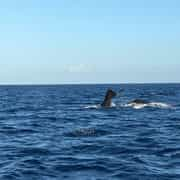
Dolphins & whale watching
Free cancellationwatersnacks
Pick the right month and a sunrise launch, and calm water meets resting pods. Spinner and bottlenose dolphins rest in Tamarin Bay year-round, and early boats reach them before the crowds. Book a dawn slot and meet the bay at its best.
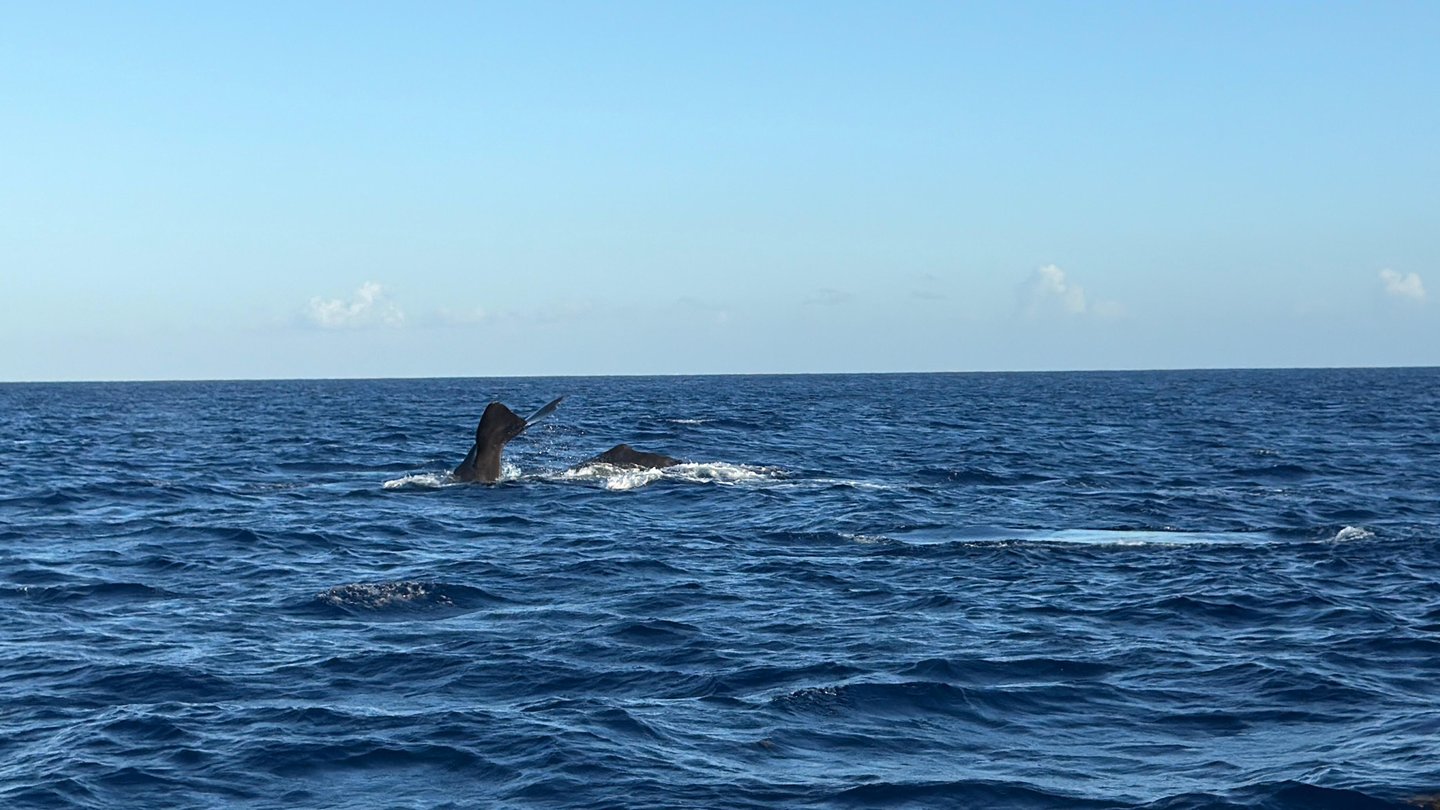
"Great tour! Swam with dolphins four times and saw four sperm whales. Stunning memories, beautiful photos. Crew always made sure the animals weren't stressed. Small group of six, highly recommended."
one boat leaves as early as 4:45 am



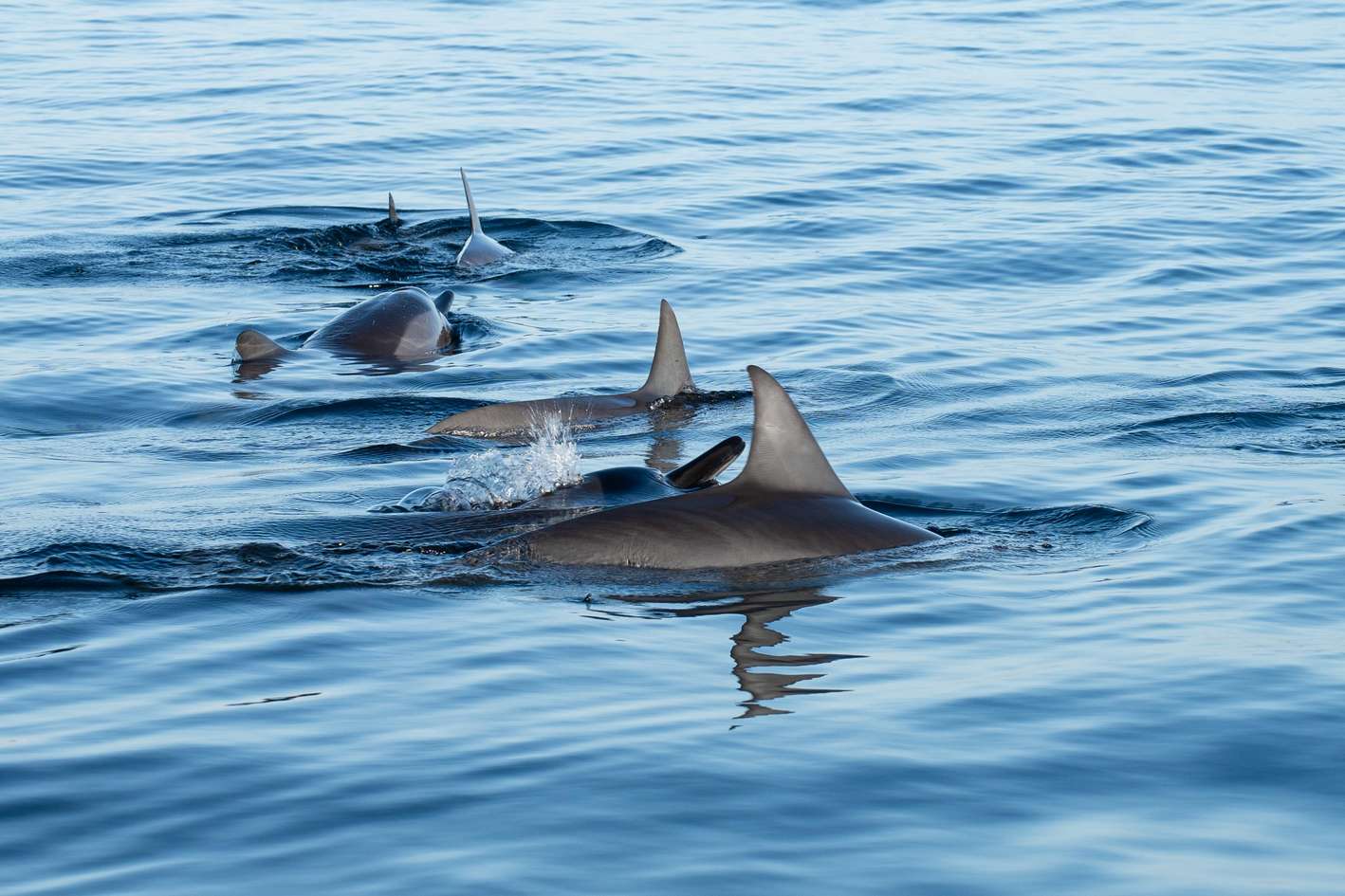

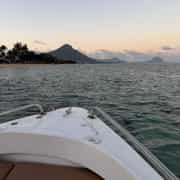
pods rest in the bay till 10:30
The pods off Tamarin Bay stay all year; the sea around them moves with the calendar. Picking the right month and the right dawn hour is what turns a boat trip into a swim.
Dolphins live off the west coast every month of the year; only the sea changes with the season.
December has the calmest water, calm on 87% of days, while May to October brings the clearest water; October balances both.
Aim for a 6:00 to 7 am launch: pods return to Tamarin Bay between 6:30 and 8:30 am and rest until about 10:30 am.
Winter water holds around 23 to 25°C, so a wetsuit is optional comfort rather than a requirement.
Cyclones can shut down departures from November to mid-May, so book the swim early in your stay and keep a spare morning.
If you travel in those months, book a tour with free cancellation up to 24 hours before departure and keep a spare day in your itinerary in case a departure is postponed.
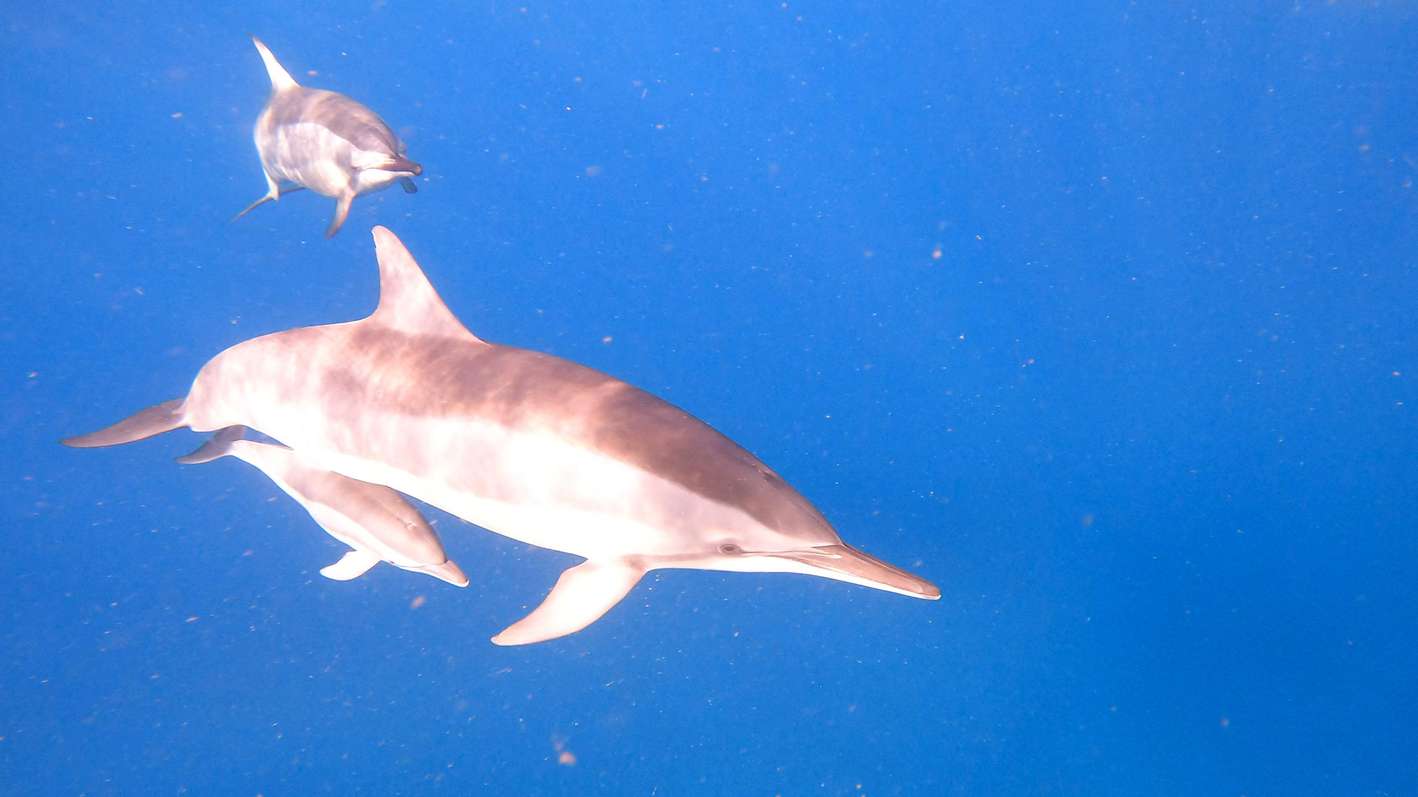
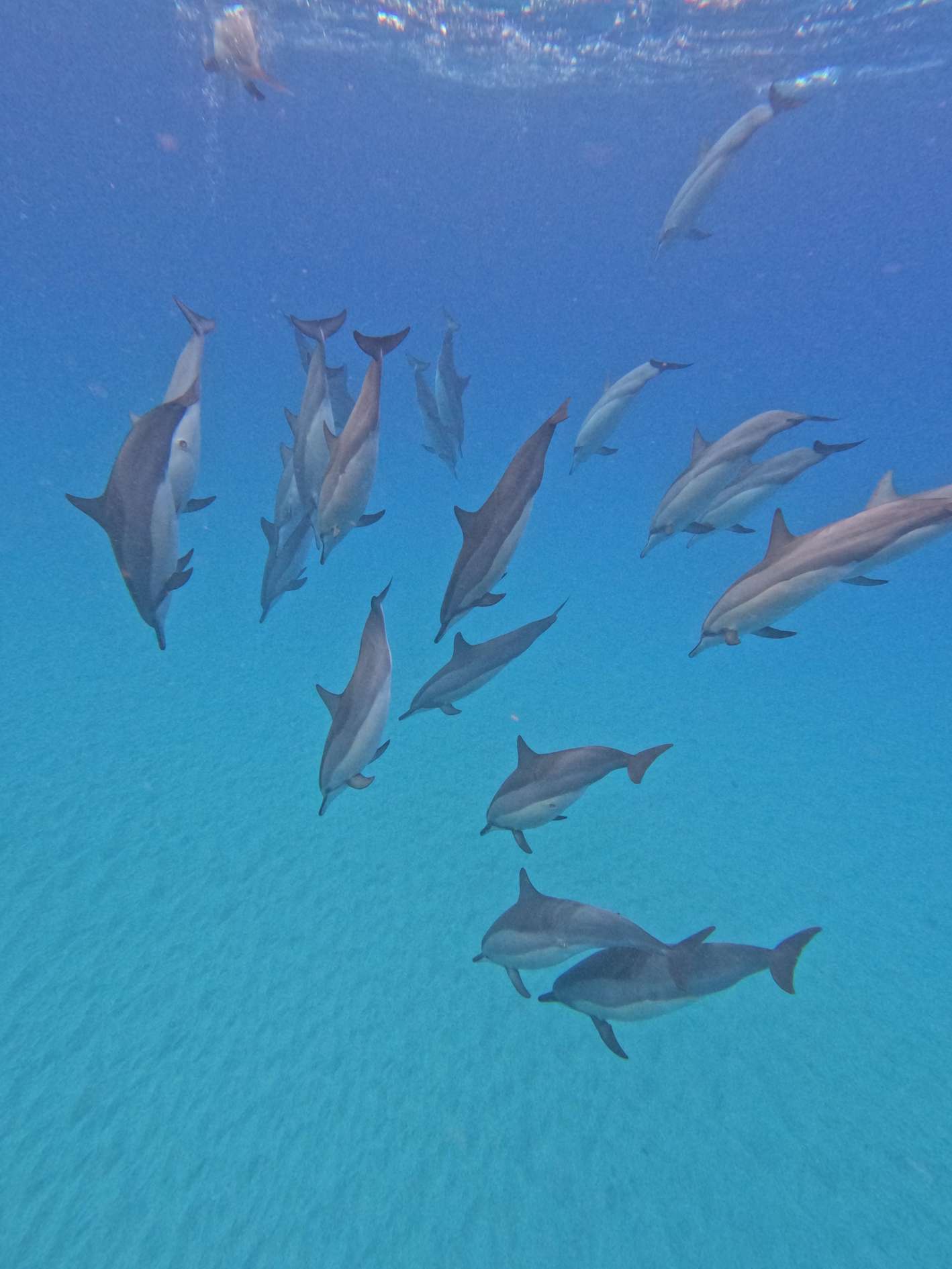
Dawn on Tamarin Bay and the water is already working: fins cutting the surface in pairs, a pod of spinner dolphins settling into the shelter of the bay after a night hunting in deep water offshore.
That scene runs through every month on the calendar. Year-round surveys find no monthly swing in dolphin encounter rates, and the spinner and bottlenose pods off the west coast are residents.
The dolphins do not leave; the sea changes. What shifts with the calendar is the water: how often it lies flat, how high the waves run, how far you can see.
Summer months run calm most days, while winter swell picks up, though the central mountains shelter this coast from the southeast trade winds that rake the island's east side.
So ask of your travel dates how the water will look on the morning you go; the dolphins will handle their half of the appointment.
September: 5 out of 5 for how busy it gets. Tours are busiest; seas are calm on 63% of days, while visibility is described as excellent in this season.
Tap a month to read it.
December: calm sea on 87% of days. Tours are moderately busy; seas are calm on 87% of days, but visibility can be reduced in the more variable season.
Tap a month to read it.
August: waves up to 1.6 m on an average day. Tours are very busy; seas are calm on 51% of days, while visibility is described as excellent in this season.
Tap a month to read it.
May: 2.6 windy days. Tours are busier; seas are calm on 56% of days, while visibility is described as excellent in this season.
Tap a month to read it.
May: 5 out of 5 for water visibility. This is described as a clear-water season.
Tap a month to read it.
Read those figures as a choice between two water states: December and February are the flattest months, while May to October brings the clearest water of the year. October sits on the seam between the two, calm on 70% of days with visibility at its best, which is why regulars keep coming back to it.

Two things you want from the water pull in opposite directions. Mauritius's summer, November to March, delivers the flattest sea: December is calm on 87% of days.
But summer is also the wetter season, and the water loses the glassy clarity of the cooler months. Winter, May to October, is drier and clearer, with the choppier swell to match: May to August see calm conditions on only about half of days.
October has calm seas on 70% of days, an average highest wave of 1.3 metres, and sits inside the clear-water season. November runs a close second and the sea keeps improving into December, when it is flattest of all.
| Summer (Nov-Mar) | Winter (May-Oct) | October | |
|---|---|---|---|
| Calm-sea days | 80 to 87% of days | roughly half | 70% |
| Water clarity | murkier | the clearest of the year | clear |
| Dry days | 9 to 12 a month | 21 to 27 a month | about 21 |
| Whale season | none | June to October | yes, near its best |
Mauritius regulars keep steering each other towards September and October: the weather has cooled from the humid peak, the sea has cleared, and the swimming is still warm. If your dates land elsewhere, do not rearrange the holiday. Pick the flattest fortnight you can and put your faith in the alarm clock instead.

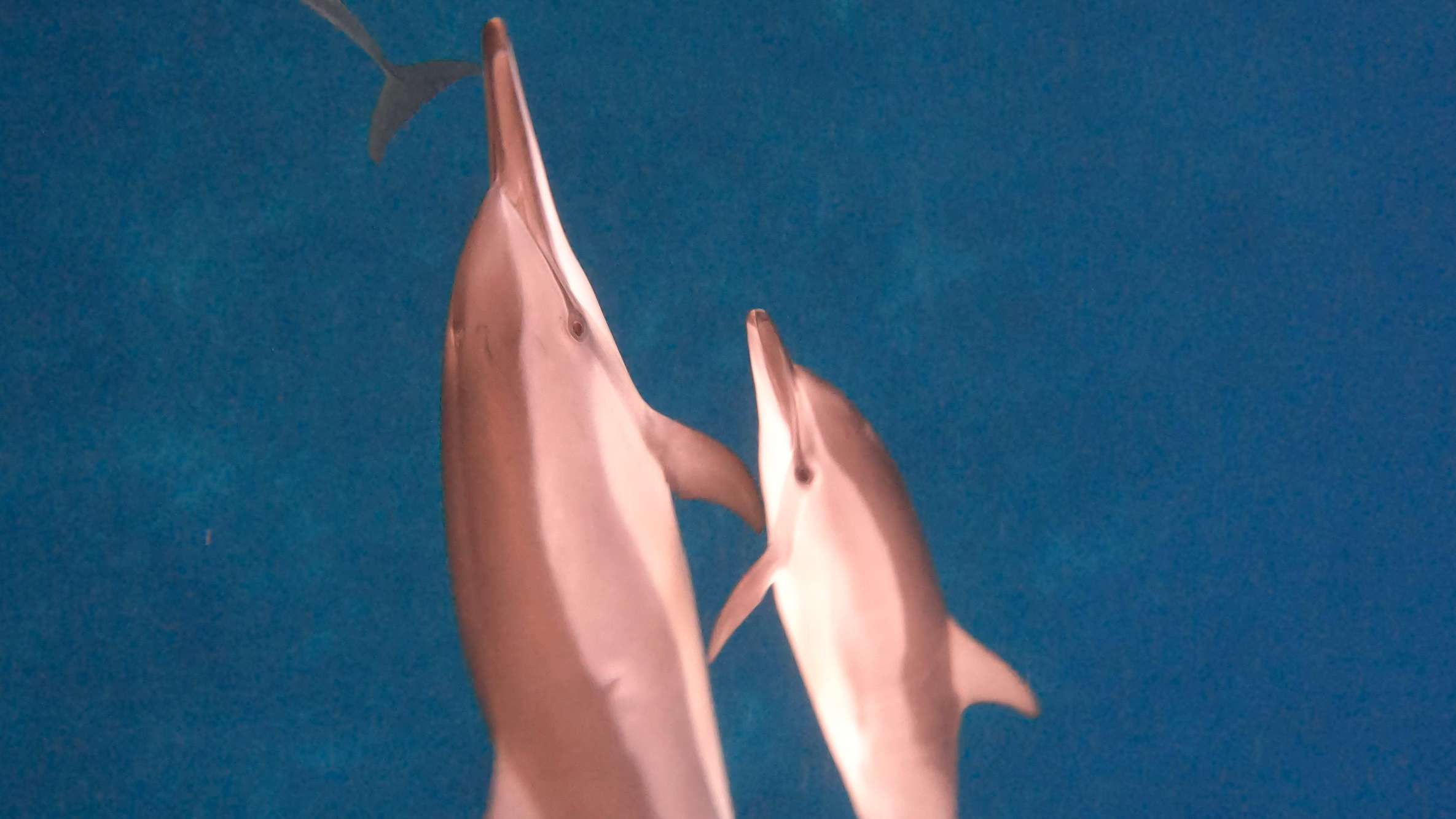
The pods keep a timetable of their own. Spinner and bottlenose dolphins hunt in deep water through the night, then return to Tamarin Bay to rest, socialise and nurse their young. They linger through the morning before sliding back out towards open ocean.
Two accounts place the return slightly differently, one from 6:30 am, the other from 7 am; they agree the bay is full by 8:30 am and that the pods rest until about 10:30 am.
That makes the window from 7:00 to 8:30 am the overlap both agree on, and a 6:00 to 7 am launch the departure to chase.
You reach the bay while the dolphins are resting near shore, the water is at its flattest before the late-morning wind builds, and the flotilla has yet to arrive. One operator schedules from 7 am in the winter months and reports many boats gathering after 8:30 am. By afternoon, encounters in the bay are uncommon.
Sunrise itself moves with the calendar, from about 5:23 am in November to 6:44 am in July, so the same departure time meets a different light depending on when you travel.
Pods return to the bay to rest and socialize; this is the strongest encounter window.
Pods start heading offshore, making sightings less reliable as the morning goes on.
Pods are generally offshore, so encounters in the bay are uncommon.
The Flic en Flac: Private Sunrise Dolphin Watching Boat Tour is built around exactly this hour: a 6:30 am start, a small 19-foot boat for at most four passengers, and a respectful 50-metre distance kept from the pod, with masks, fins and beverages on board.

The 5:30 am alarm in July raises a fair question: how cold will that first plunge feel? The answer is gentler than the latitude suggests. Mauritius's winter seas average 23 to 25°C, and the nearby figures hold up month by month, from about 25°C in June to about 23°C in August and September.
That is a comfortable swim by any open-water standard. You do not need a full neoprene wetsuit for a dolphin swim here; a scuba body recommends one for winter diving, but that is a different activity at depth.
For a surface swim of a few minutes at a time, a thin shorty is the most you would want, and only if you chill quickly or plan long spells in the water.
The air is the cooler half of the equation. Winter mornings on an open speedboat carry a breeze, which matters more before sunrise than in it. The west coast is also the sheltered side of the island in the winter trade-wind months, so the water you drop into is flatter than the forecast suggests.
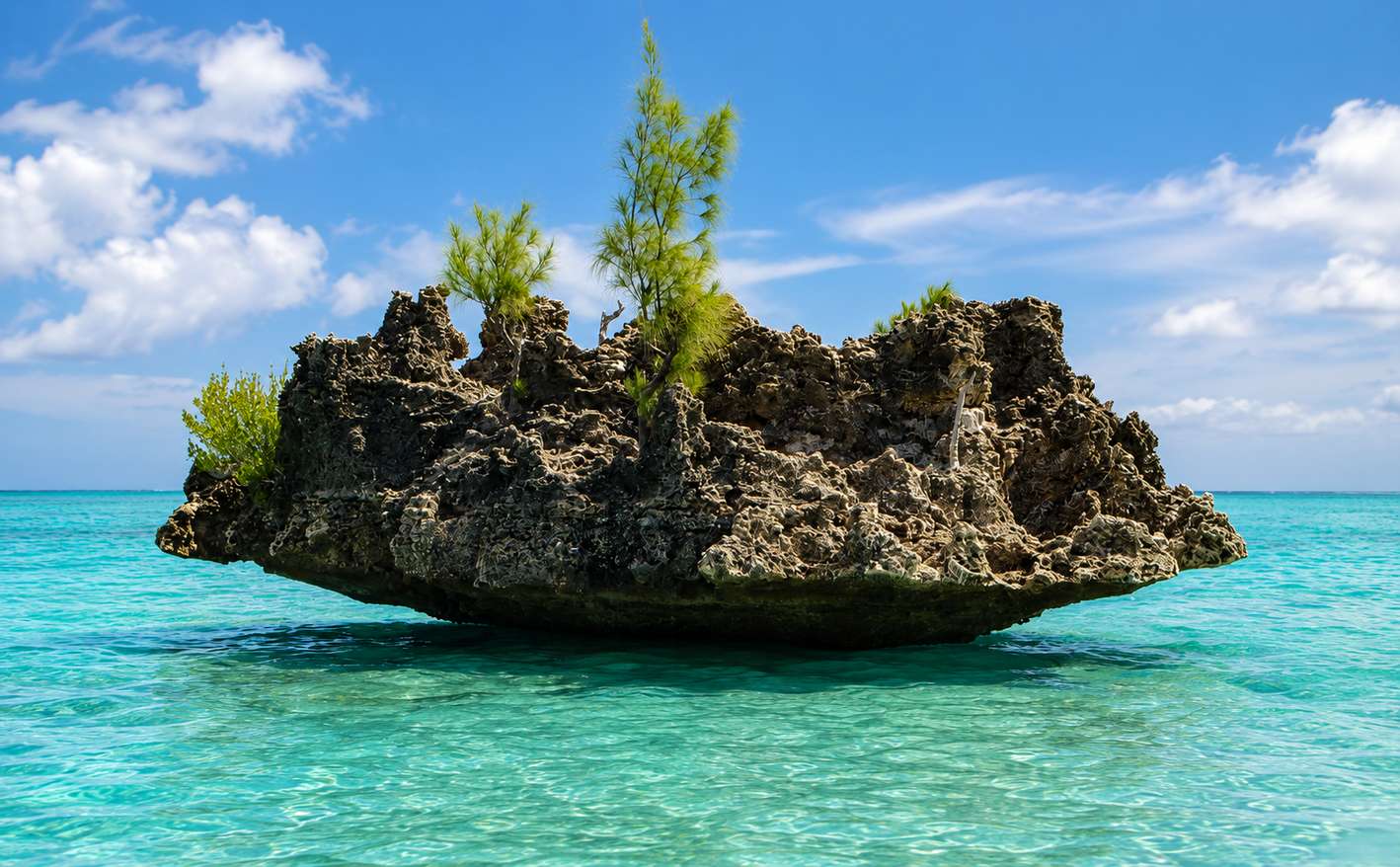
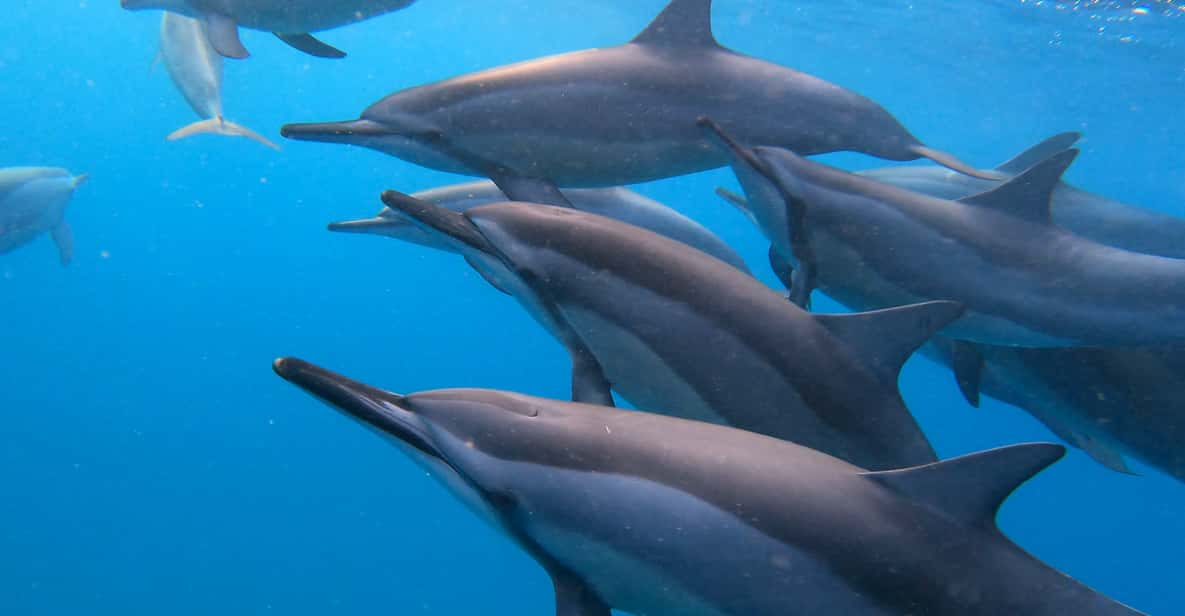
The summer months that bring the flattest seas also bring the season when the sky can close the harbour.
Tropical cyclones and the weather safety bans that come with them can shut down boat departures from November through mid-May, with the highest risk between January and March. The odds any single morning is lost are small, but the season is real and worth planning around.
The other stopper is swell. Mauritius issues a heavy-swell warning when waves of 4 metres or more are likely near the island, and rough seas reduce visibility enough to cancel dolphin trips on their own.
When the sea turns, operators may change the itinerary for safety, and after a cancellation they commonly offer a refund or a new date; the detail differs from boat to boat.
Tropical cyclones and safety bans can shut down boat departures from November to mid-May, peaking January to March Book your dolphin swim for the first days of your stay and keep a spare morning free
That second half is the whole trick. A dawn swim scheduled on day two of the holiday can be moved; one scheduled on your last morning cannot.

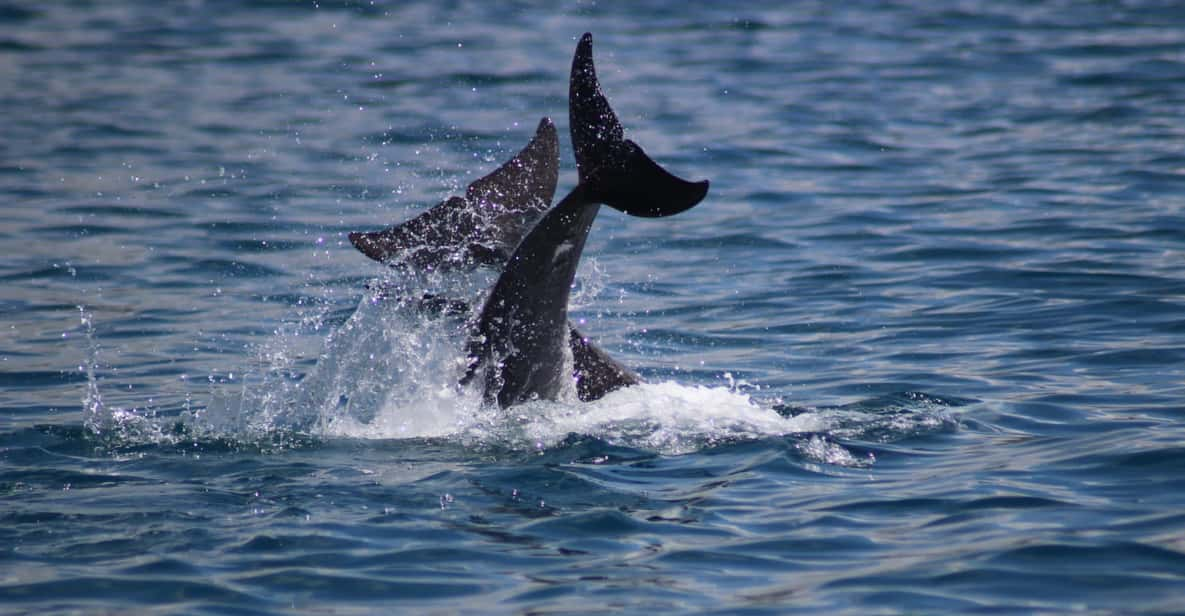
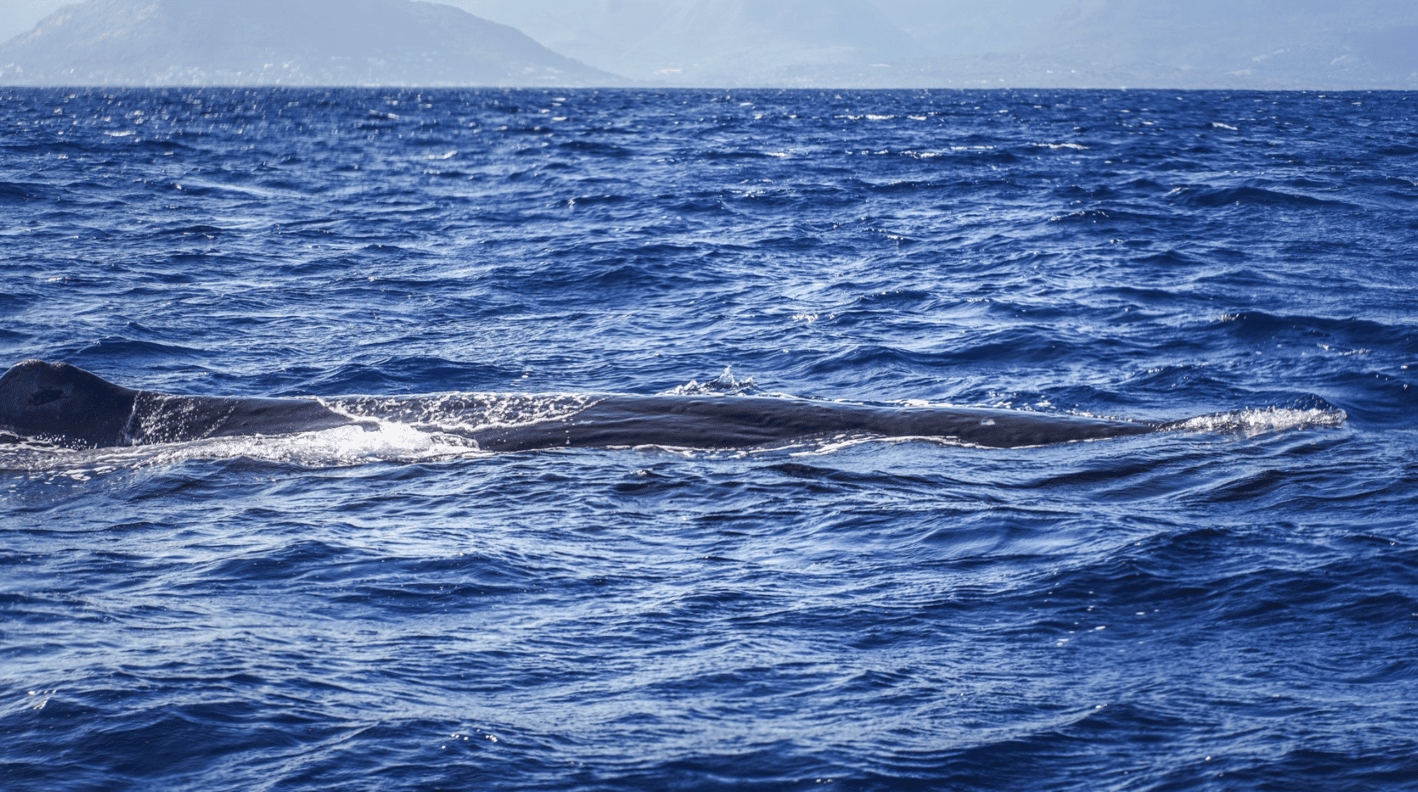
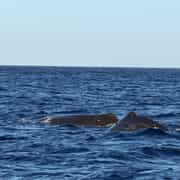
If your dates fall between June and October, a second species shares the water. That window is humpback whale season off Mauritius, and the overlap in local humpback, sperm-whale and dolphin records is strongest from August to October.
Sperm whales are recorded in other months too, though a record is not a promise of a sighting on your morning.
The two fit in one trip. A combined dolphin swim and whale-watching speedboat run from Black River takes about five hours launch to return, extending to five and a half on private charters, usually leaving at 7 am and getting back to the jetty around midday.
Take the earliest departure you can: a 6:00 to 6:30 am launch from Black River crosses the reef pass on the flattest water of the day.
The Black River: Dolphin Swim and Whale Watching by Speedboat tour does exactly this, pairing the morning dolphin swim with a run offshore in search of resident sperm whales and, in season, humpbacks, with snorkelling gear and soft drinks aboard.
Whales carry stricter rules than dolphins: skippers must stay at least 100 metres out, and swimming with whales is prohibited. You watch them from the boat; the law keeps it that way.
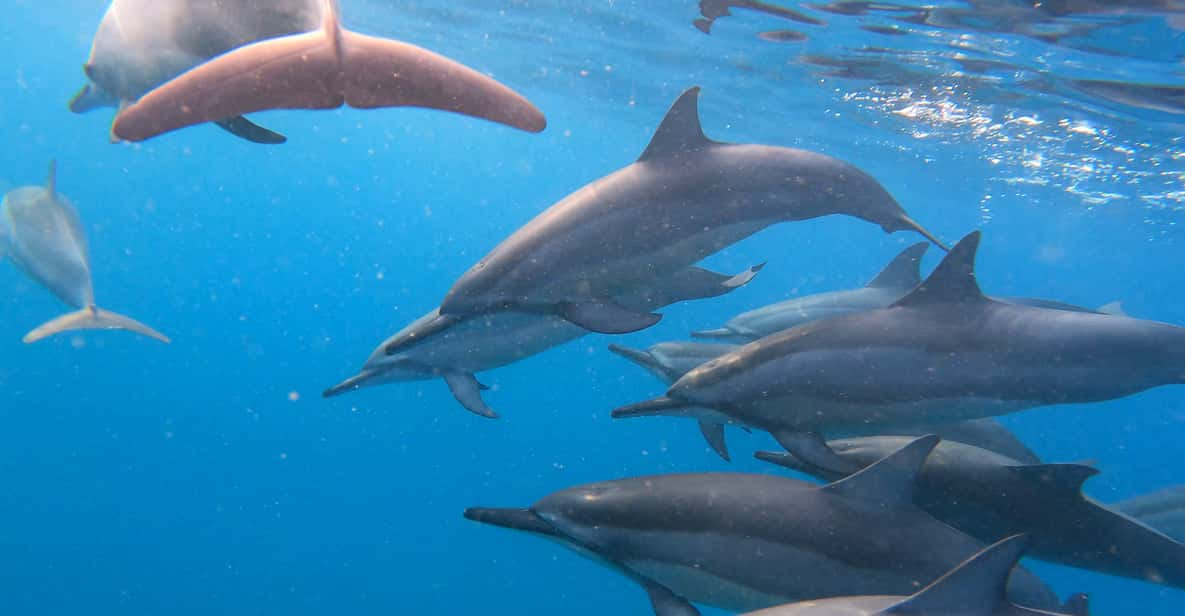
By mid-morning the quiet changes character. Travellers describe a dozen or more boats converging on whichever pod has been found, engines idling, swimmers dropping in one after another, until the outing feels more like watching boats than watching dolphins.
Kayakers report paddling farther out because speedboats push the pods offshore, and the constant presence disturbs the dolphins' rest enough that they flee or change their habits.
The hour defends you first. A 6:00 to 7 am launch reaches the water before the gathering starts, and the dolphins at that time are described as curious and playful.
The operator matters just as much, and our guide to ethical dolphin tours in Mauritius goes deep on the difference: a responsible boat keeps its distance, avoids pods already surrounded, and lets the animals decide whether to approach.
a quiet patch of water can still hold dolphins underneath, so scan patiently
dolphins approach on their own terms when nothing chases them
passengers who speak up change how the morning goes
If your own boat crowds a pod or another one does, say so. Ask the crew to back off, and move away if the dolphins start to look agitated.

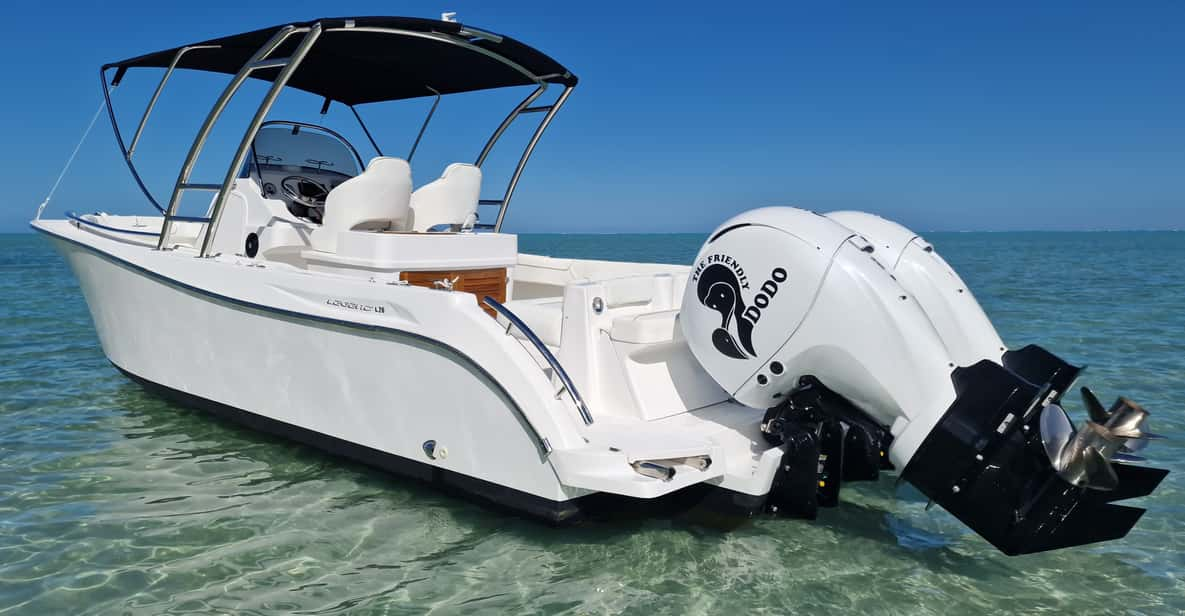
Swimming with wild dolphins is legal in Mauritius, and it is one of the more tightly regulated activities on the water.
Paid operators need a specific licence for dolphin watching with swimming, a certified skipper, an approved propeller guard, a life-saver, first-aid and oxygen kits, and liability insurance. Before anyone enters the water, every swimmer signs a disclaimer and sits through a briefing on calm, silent swimming.
The rules in the water are just as specific. Boats stay outside a 50-metre prohibited zone around the pod, travel at no-wake speed through the regulated zone beyond it, and always approach from the side, parallel to the animals.
No more than three people, including the life-saver, may be in the water at once. Touching and feeding dolphins are prohibited, as is free-diving above them, making noise to attract them, or circling them. Everyone aboard a commercial boat outside the lagoon wears a flotation device, children included.
Drones stay home too: recreational flying is restricted to private property and never over the sea. The ethical dolphin tour guide walks through what these rules mean for the animals themselves.
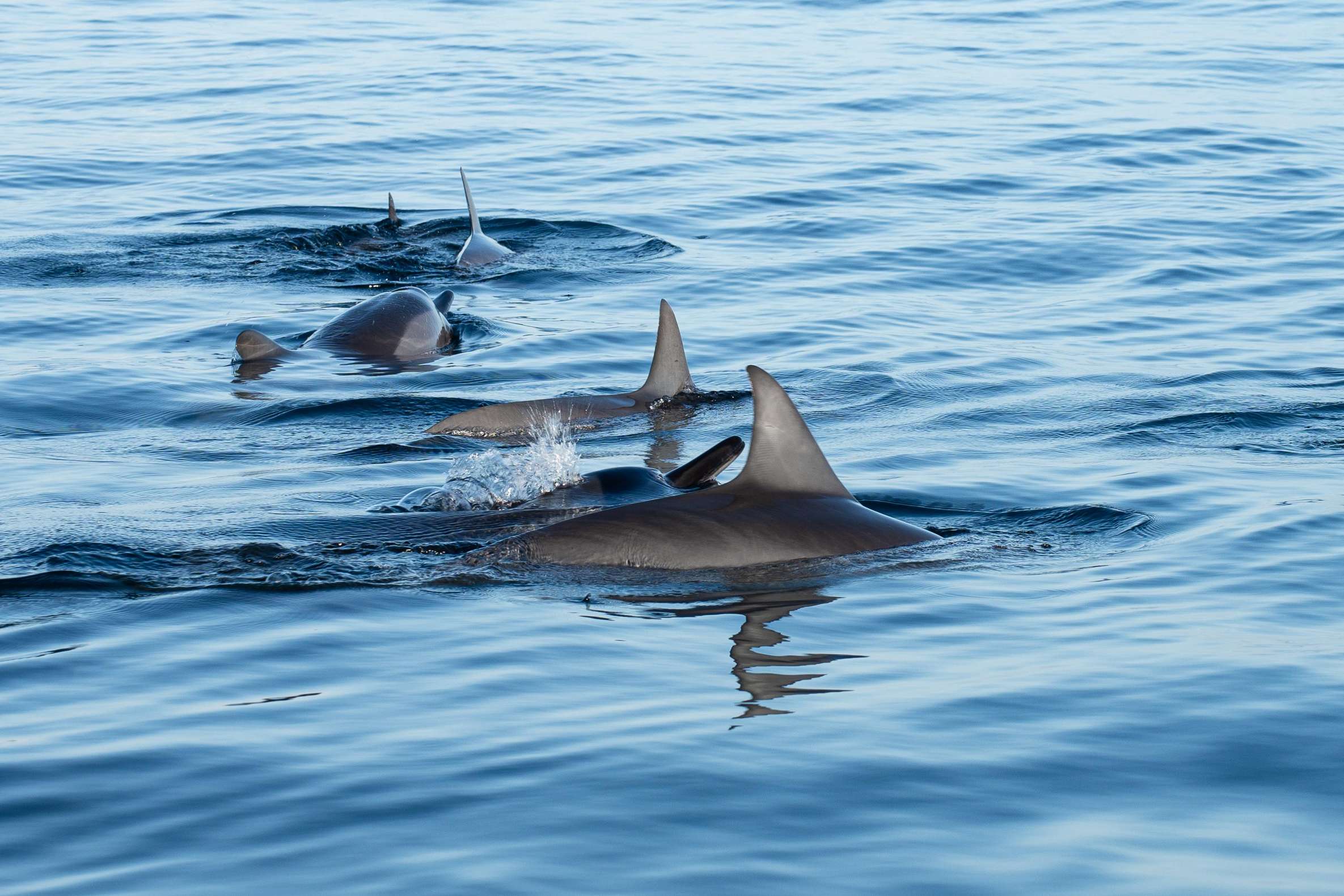
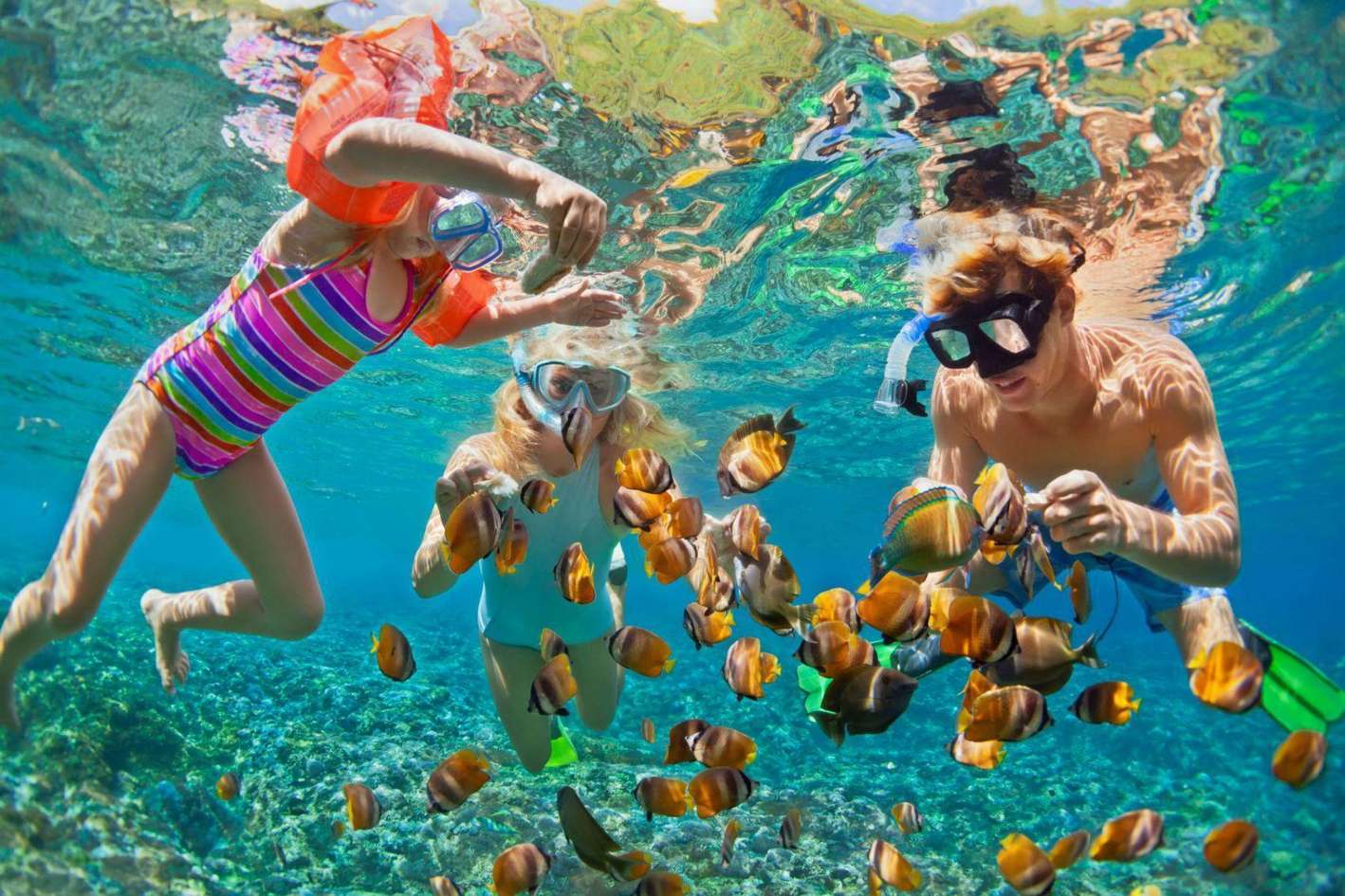
The boat slides parallel to the pod, the guide gives the word, and three swimmers slip in quietly with mask and fins. Then the dolphins decide.
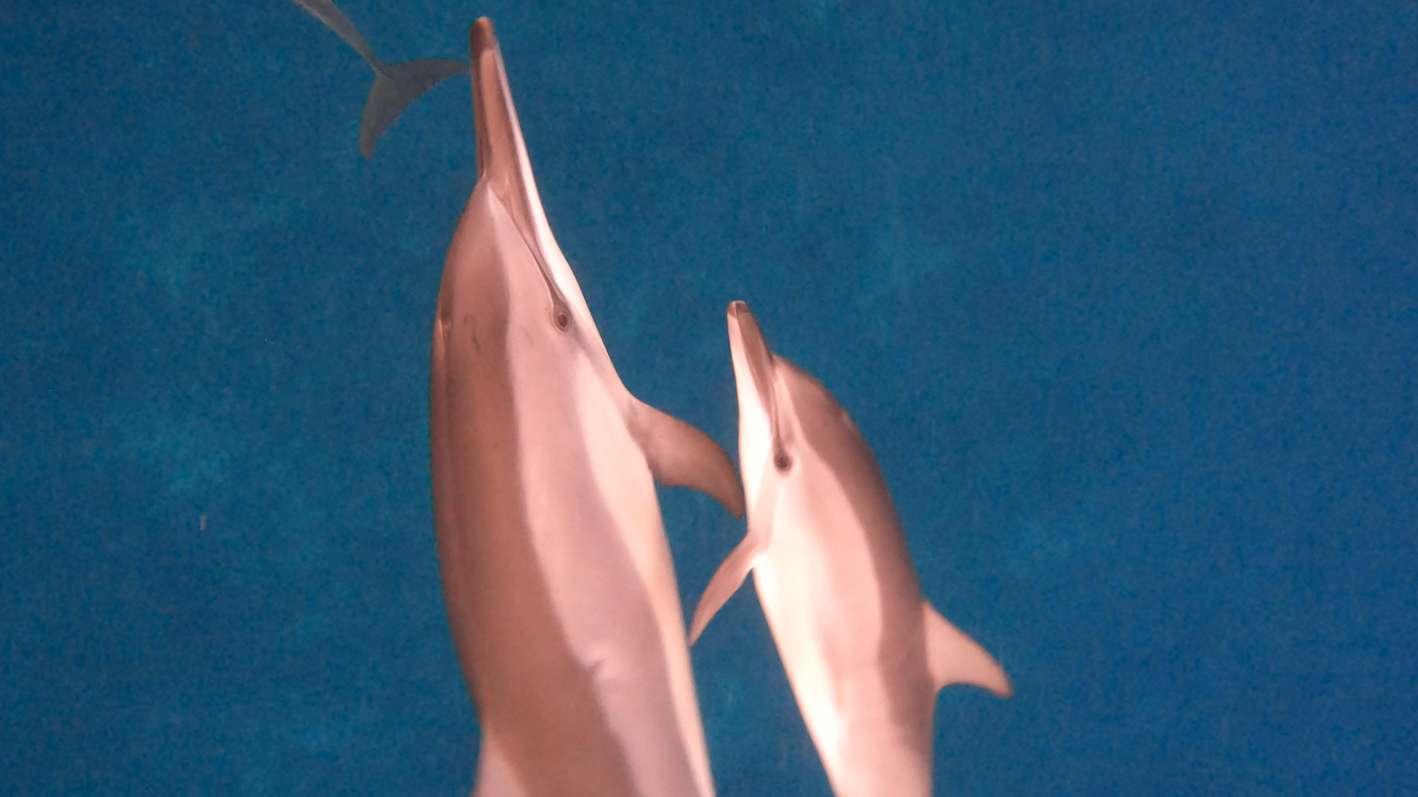
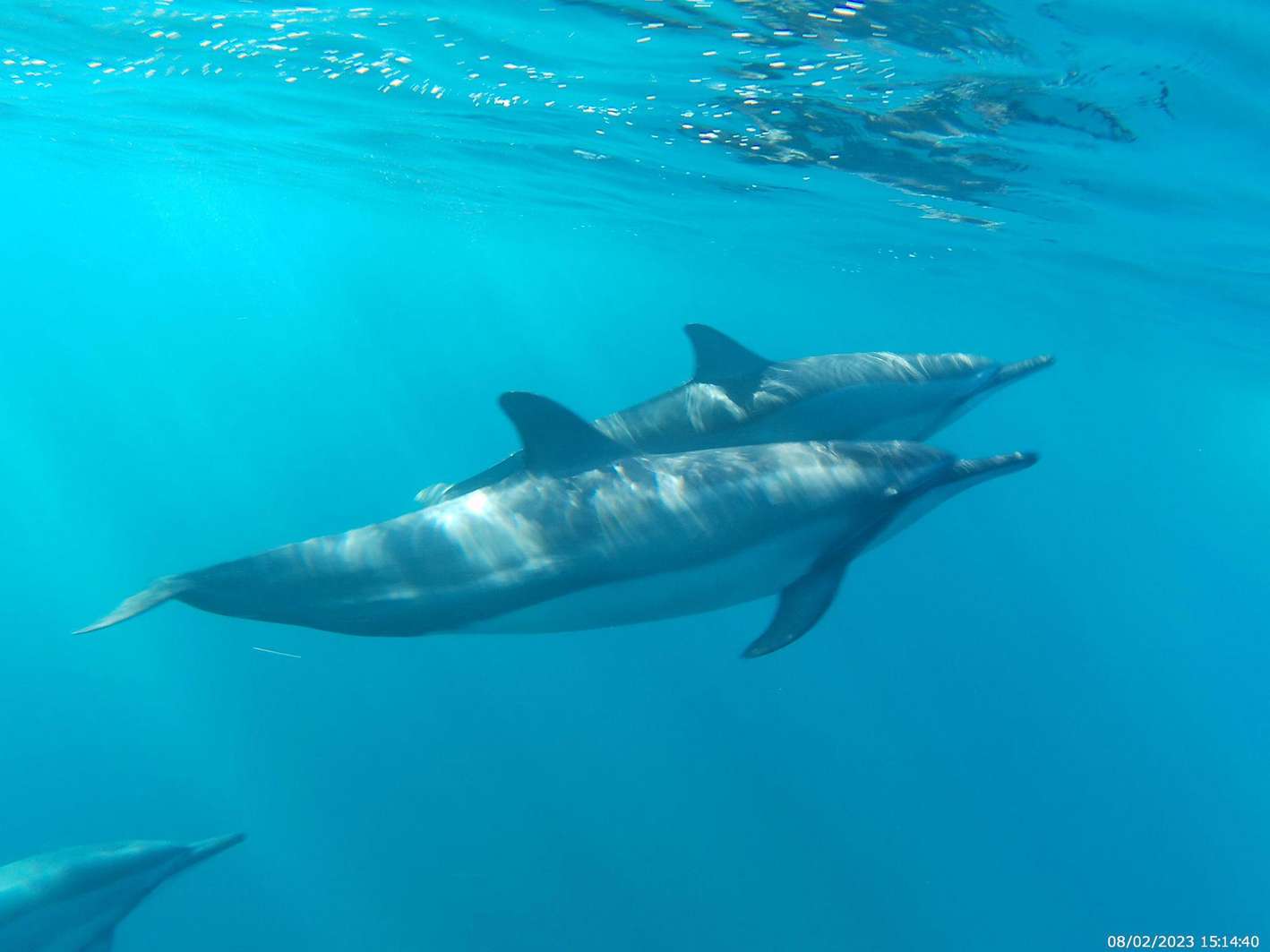
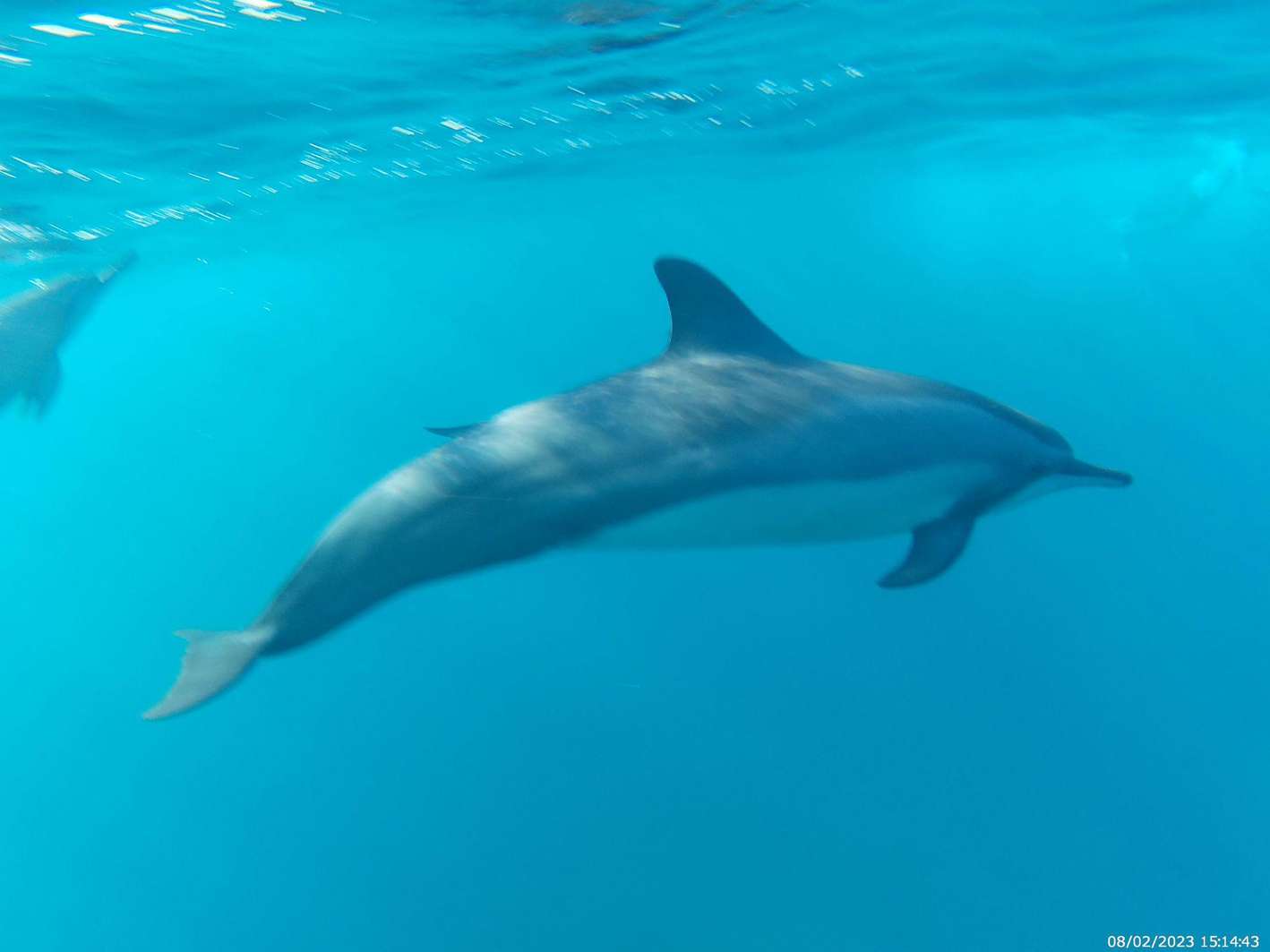
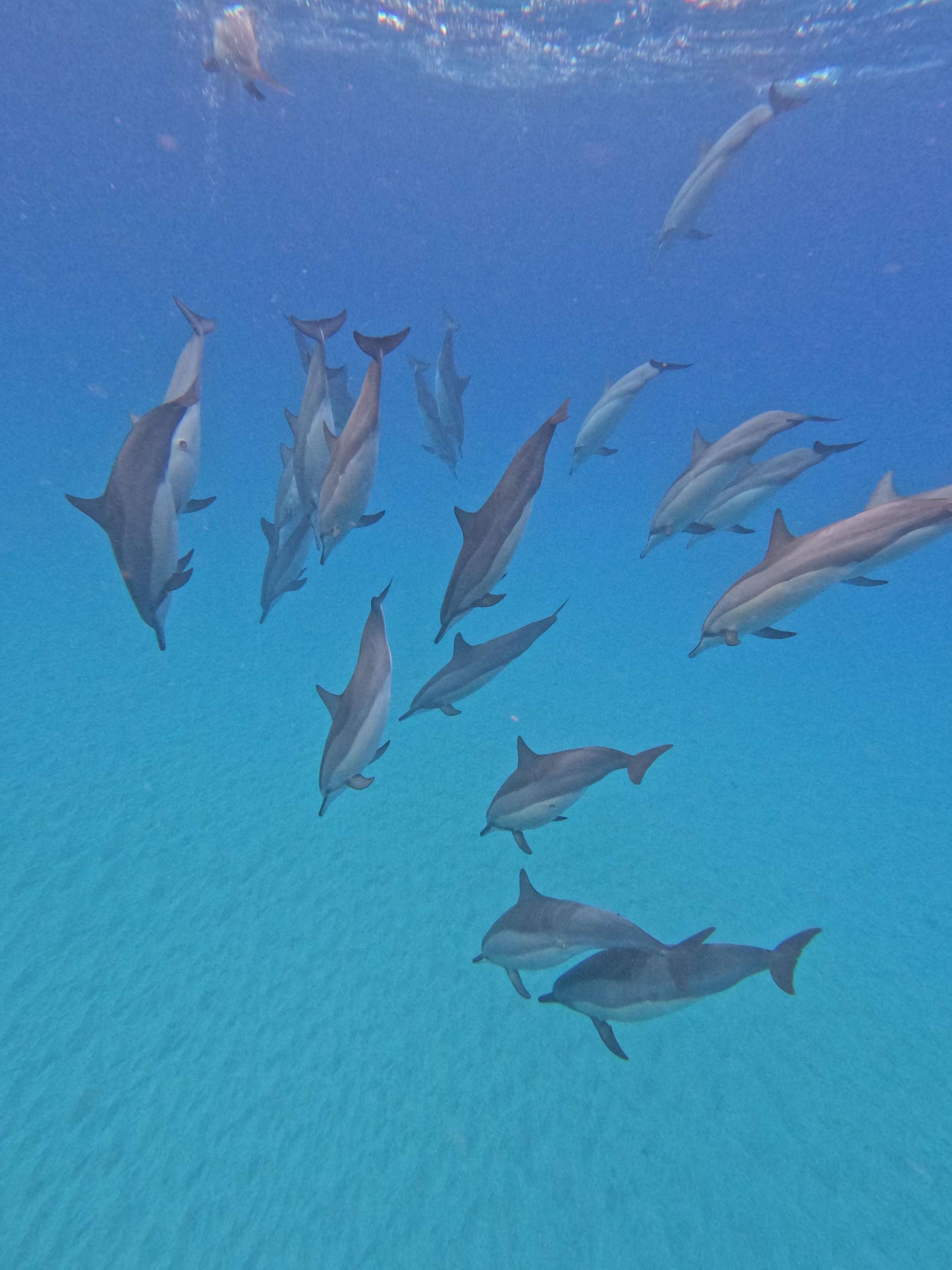
What travellers describe, again and again, is a brief pass as a wild pod moves through: the animals a few metres below, clicking and whistling audibly as they glide past. Sometimes they curve in to look. Sometimes they swim away.
This is the honest shape of it, and the main dolphin swimming page explains how the tours themselves run. Nobody controls a wild animal.
The guide's job is to place you on the dolphins' path, keep you calm and quiet, and pull you out at the right moment; your job is to enter without splashing and let them come or go.
Wild dolphins choose whether to come close; many simply glide past a few metres below
Touching is prohibited, and most encounters keep a distance
Circling is curiosity about something unusual, not an invitation
They also look bigger down there than from the rail. That is the point of going.

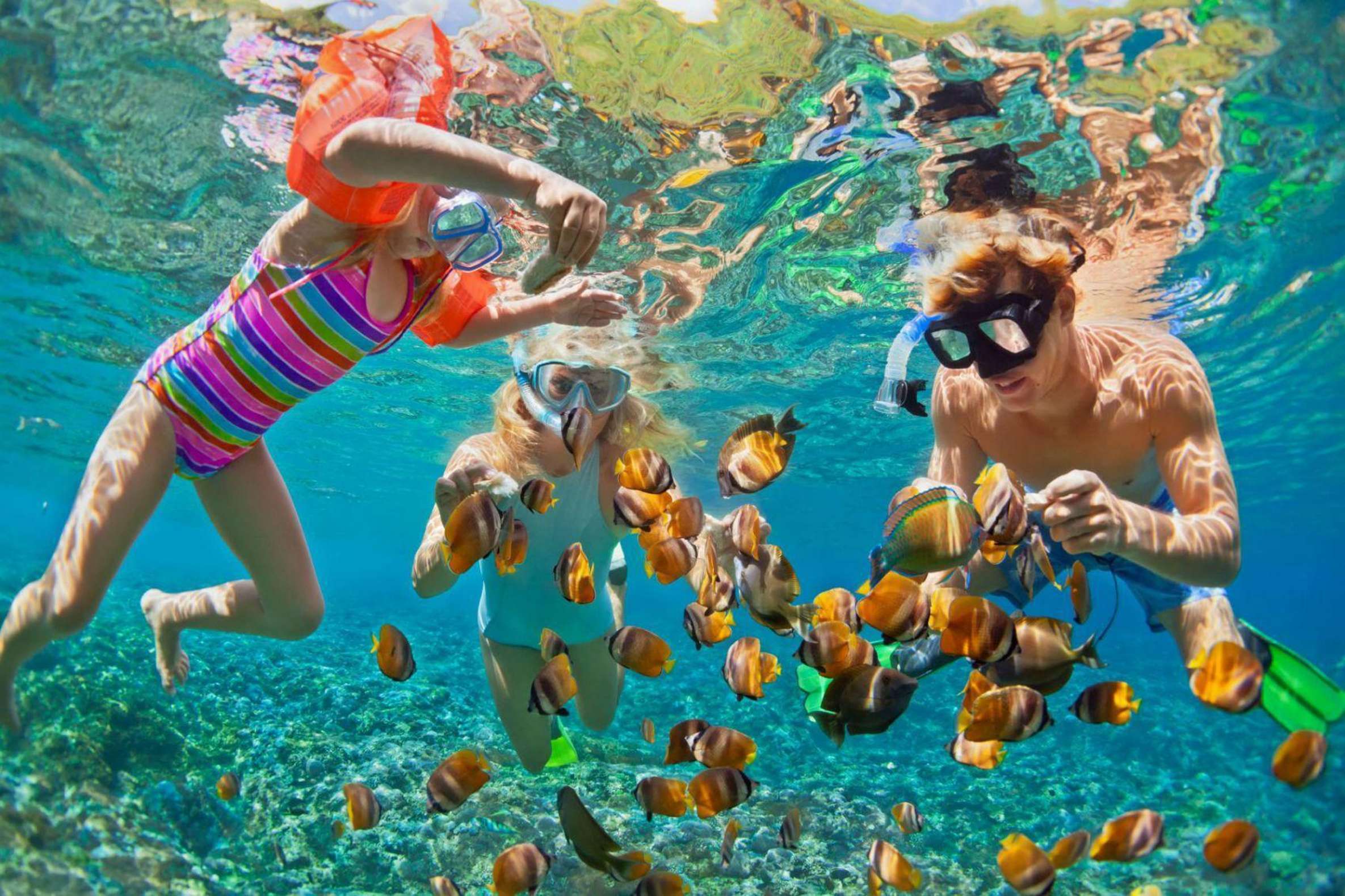
The swim asks more than a resort lagoon does. The honest benchmark is being able to cover 50 metres without panic in choppy water wearing mask and fins, to drop into deep water from a moving boat, and to manage repeated climbs back up the ladder.
Currents outside the barrier reef can run faster than half a metre per second near Le Morne and Black River, and water pushes hard through the passes on a falling tide.
A brief free-dive of two or three metres on a held breath helps when dolphins sound beneath you.
Some operators check this before letting you in and may decline if someone looks unsure in the water; that is the safety system working.
Limits also vary by boat: several tours rule out pregnant travellers, one excludes people with heart problems, and age minimums range from under 1s and under 3s being unsuitable on some boats to ages 4 and up on another.
Watching from the deck is a first-rate outing in its own right, and the hour, the light and the flat morning water are the same. If jumping in among boat traffic gives you pause, stay aboard and let the swimmers have the water.
Every dolphin morning on Mauritius starts with a drive in the dark. The boats work the west coast: Tamarin Bay is the main ground, with Black River and La Preneuse the departure points nearest it, and Flic en Flac and Le Morne farther along.
One comparison of sites put Le Morne at the highest sighting rate and Black River at the lowest, though all of them hold dolphins on a good morning.
Boarding is refreshingly informal.
Tours meet at Tamarin Public Beach near the Fish Landing Station, on La Preneuse beach, at the jetties off La Jetée Road in Grande Riviere Noire, at Flic en Flac Public Beach, or directly on Le Morne Public Beach, where the car parks are large and free and you find your skipper on the sand.
The drive is the part that catches people out. For a 6 am launch from Tamarin, leave Grand Baie by about 4:55 am without traffic, or roughly 5:25 am for a 6:30 am start, and add margin for check-in.
Hotels on the east or north face a long, dark road; staying west the night before buys back an hour of sleep.
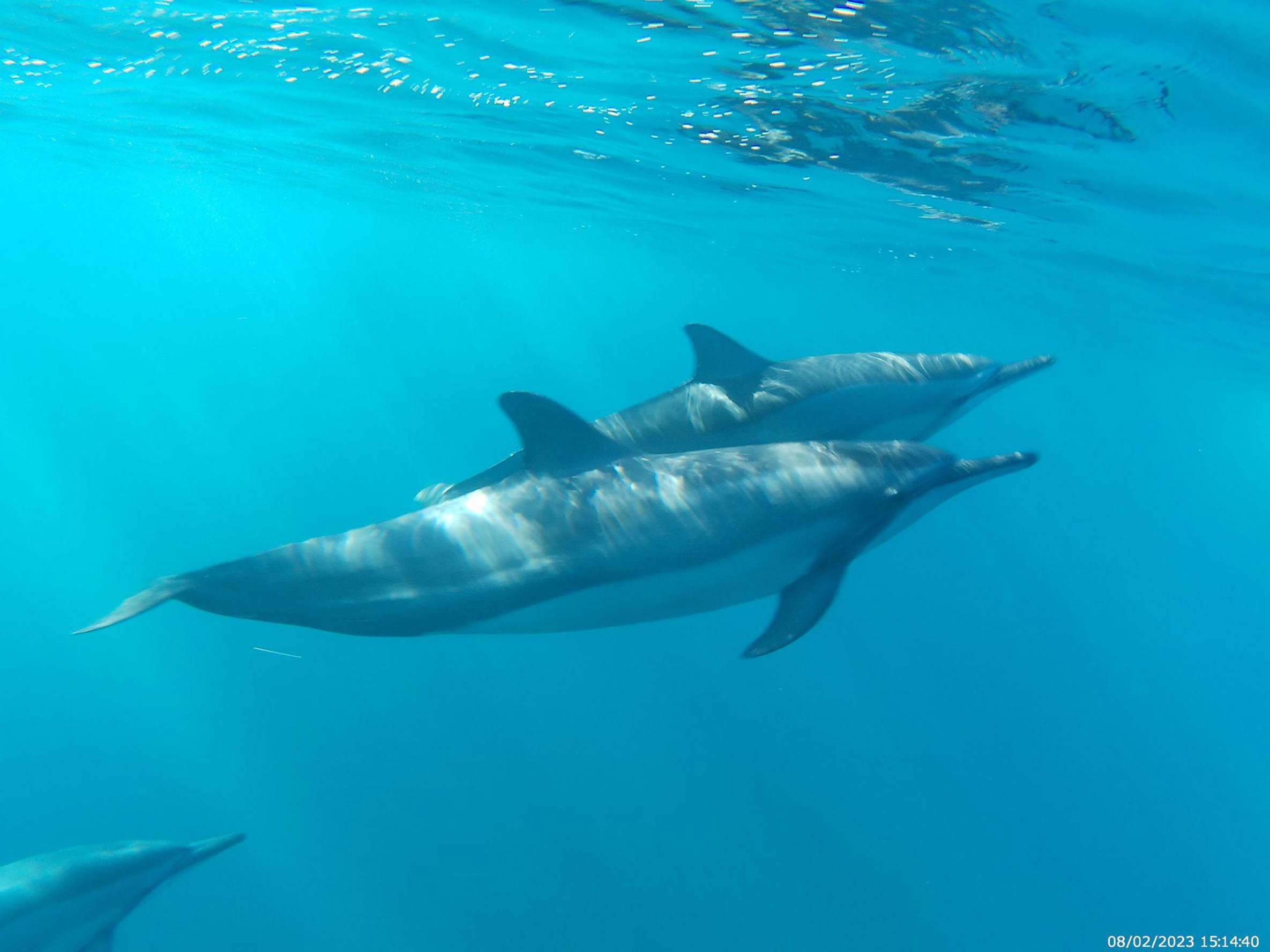
Dress for two climates. Wear your swimsuit under your clothes for the early start, and throw a light windbreaker or sweatshirt over the top for the breezy run out.
On your feet go closed-toe water sandals with grippy soles, which hold on wet fibreglass decks and guard against coral on beach landings. A 10 to 20-litre roll-top dry bag keeps a towel and dry clothes safe from the spray, with your phone in a waterproof pouch on a lanyard.
Bring a fitted mask and fins of your own if you have them; communal gear leaks, and a leaking mask is how people miss the three seconds a dolphin passes. If motion sickness ever finds you, sort prevention before boarding, sit near the centre, and keep your eyes on the horizon.
Book the boat early in your stay and pick a small or private morning departure; the La Preneuse: Dolphin Swimming and Snorkeling Speedboat Trip starts at 7:30 am from La Preneuse beach, with a guide who calls your water entry and a private option to set your own pace.
A tip for the crew at day's end is the norm on full-day boats.
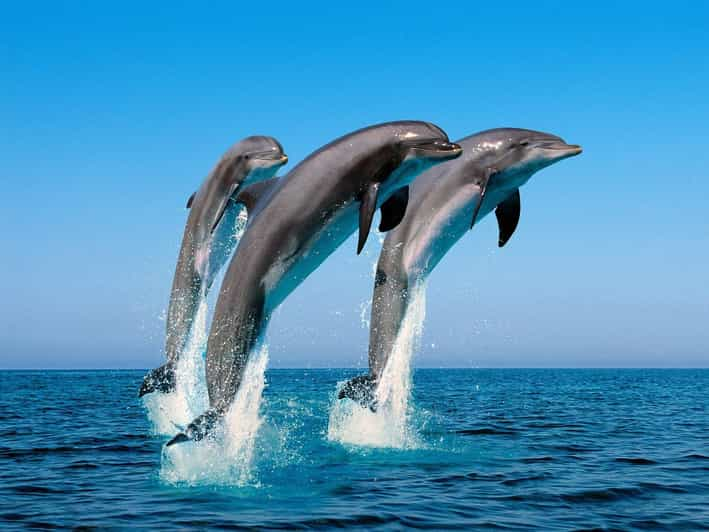
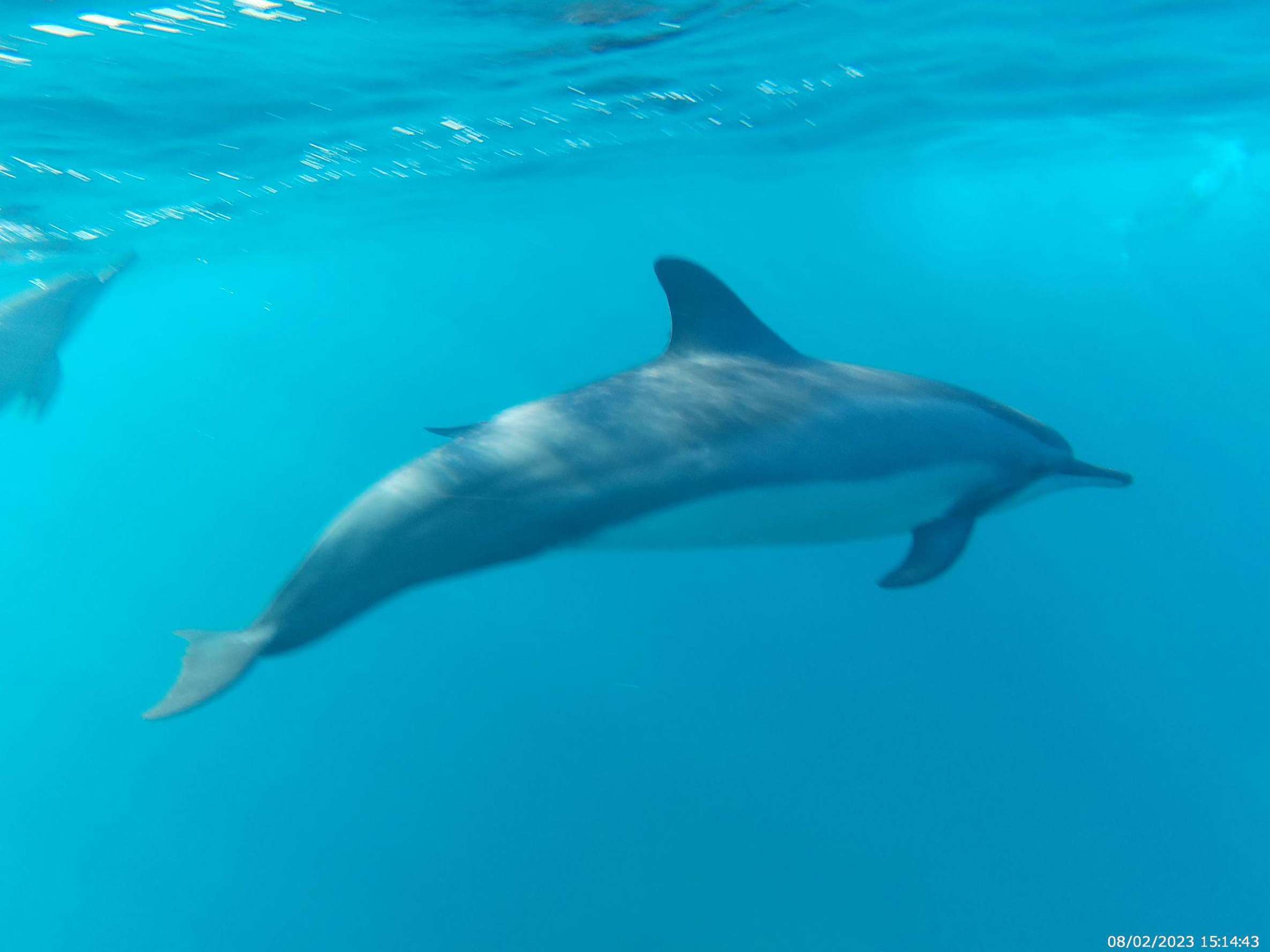
The dolphins are there all year; the sea and the hour decide the rest. Aim for a 6:00 to 7 am launch on a small boat, October to December if your dates allow, and book it for the first morning of the trip with a spare day behind it.
october: calm on 70% of days, clearest water
How licensed operators run a respectful encounter, so your calm-morning swim stays kind to the pods.
What a dawn swim costs and what belongs in the ticket, once your dates and departure hour are set.
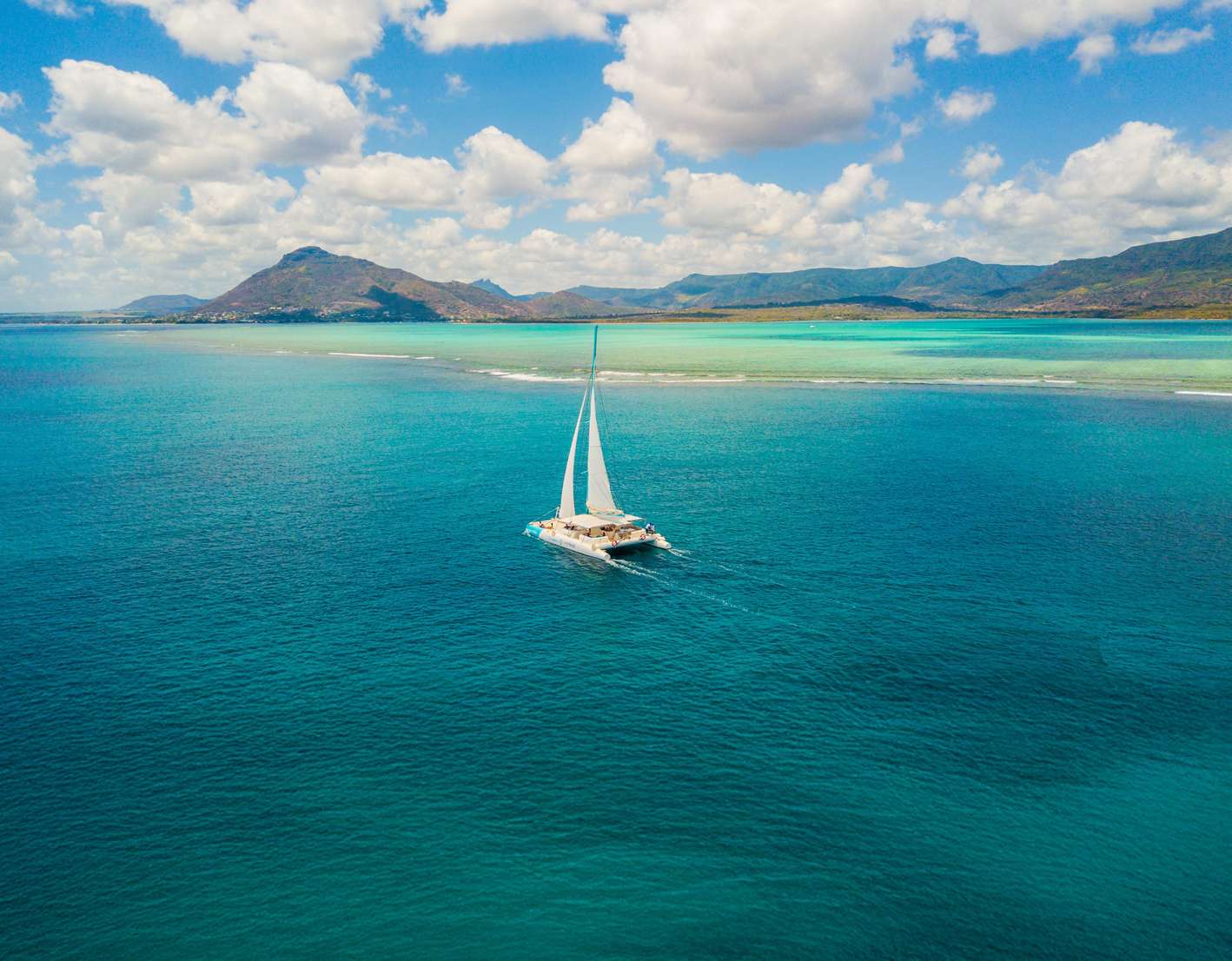
A full sailing day with lunch on Île aux Bénitiers, a gentle option when winter seas turn choppy.

A quiet paddle at first light, when the sea is flattest and the pods are resting in Tamarin Bay.
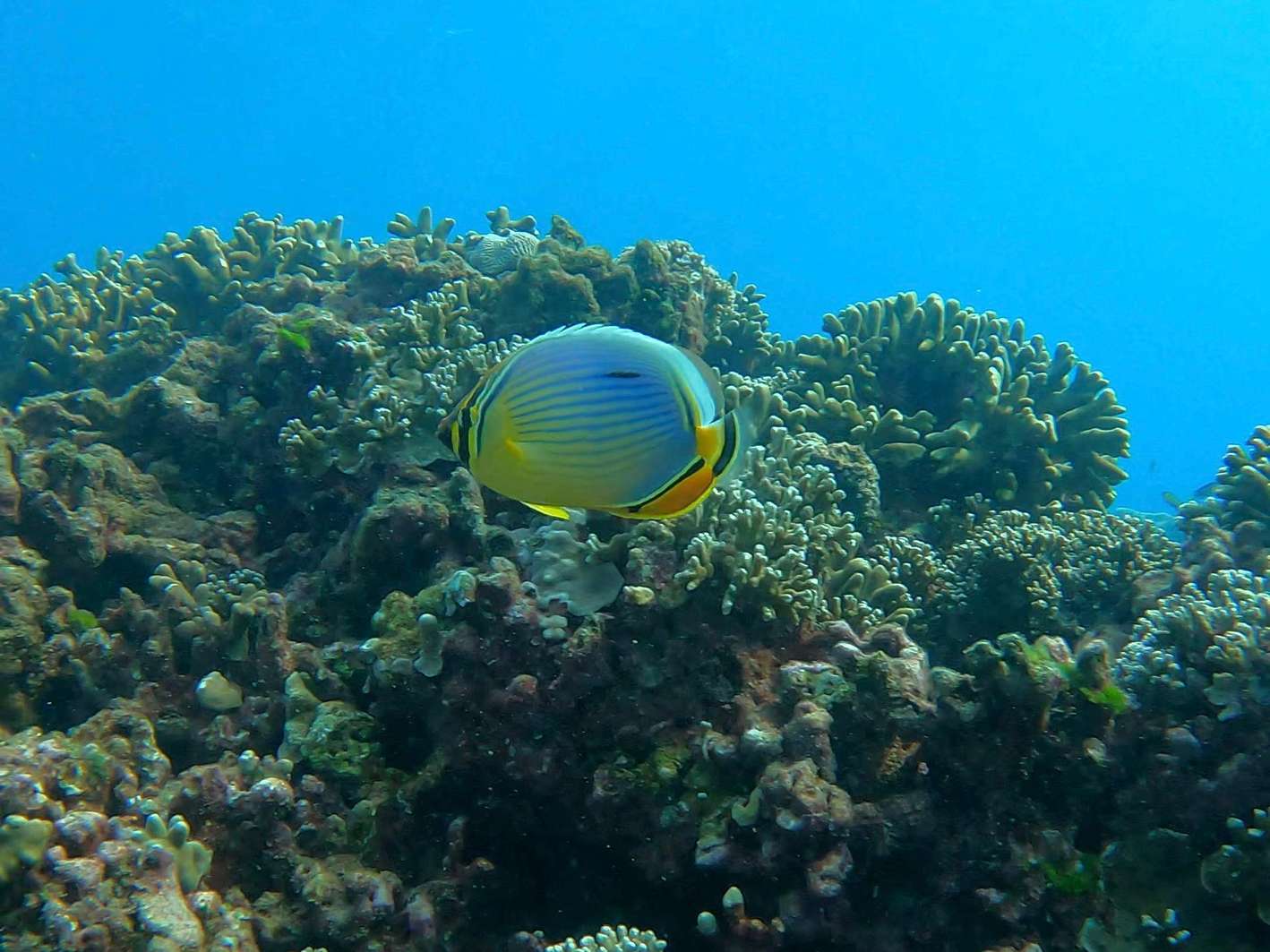
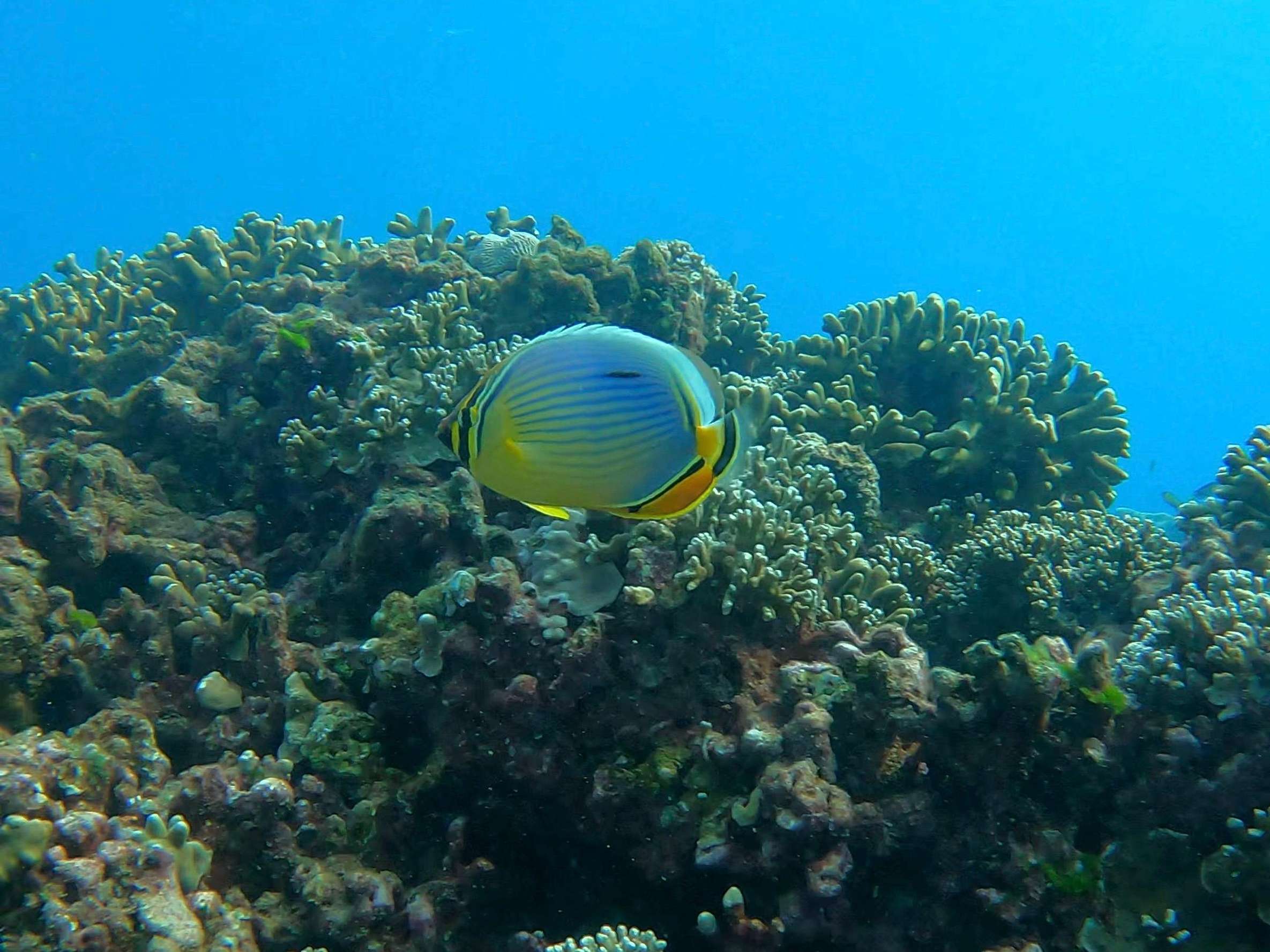
Where the clearest-water months reward you underwater, with fish and coral below the dolphins.
The June to October window for humpback whales alongside the resident spinner and bottlenose pods.
october: calm sea and clear water
Quick answers on months, morning hours, water temperature and what the season really changes.
Grande Riviere Noire2026Aim for October: it sits in the clear-water season, the sea is calm on about 70% of days, and the average highest wave is 1.3 m. Sightings stay possible all year.
Yes. Year-round surveys found no monthly pattern in dolphin encounter rates, and spinner and bottlenose dolphins live off the coast permanently. Your travel dates should not keep you from booking.
December has the flattest water, with calm conditions on 87% of days, and February is close behind at 85%. The trade-off in the December to February summer months is more rain.
May to October is the clear-water season. October overlaps with calm seas, which makes it the single month that covers both at once.
Go early. Pods return to Tamarin Bay around sunrise after feeding offshore overnight, and the most reliable window is roughly 6:30 am to 8:30 am. After mid-morning the dolphins move out to deeper water.
Encounters in Tamarin Bay are uncommon in the afternoon, when most pods have already left for deeper water. If your schedule only allows a late trip, treat it as a boat day rather than counting on a swim.
Winter sea temperatures average 23 to 25°C, so most swimmers are fine without one. Bring a light layer for the breezy boat ride, since the early starts feel cooler out of the water.
From June to October, humpback whales migrate past the west coast, and the strongest overlap with dolphin records runs from August to October. Sperm whales appear in other months too, though sightings are never promised.
An early launch gets you to the dolphins before other boats gather, so the encounter feels quieter and the sea is usually at its flattest. Travelers often describe the dolphins as curious and playful at that hour.
Yes. It is a licensed activity, and operators must carry a certified skipper, a life-saver and safety equipment, with no more than three swimmers in the water at once. Swimming with whales is prohibited.
Dolphins and sharks can share the same water because they eat some of the same food, so a sighting says nothing about sharks either way. Licensed tours follow strict safety rules regardless.
Tamarin Bay is the main dolphin-watching area, and most boats launch from there, from Black River or from nearby La Preneuse, all on the sheltered west coast. A few sunrise trips also leave from Flic en Flac.
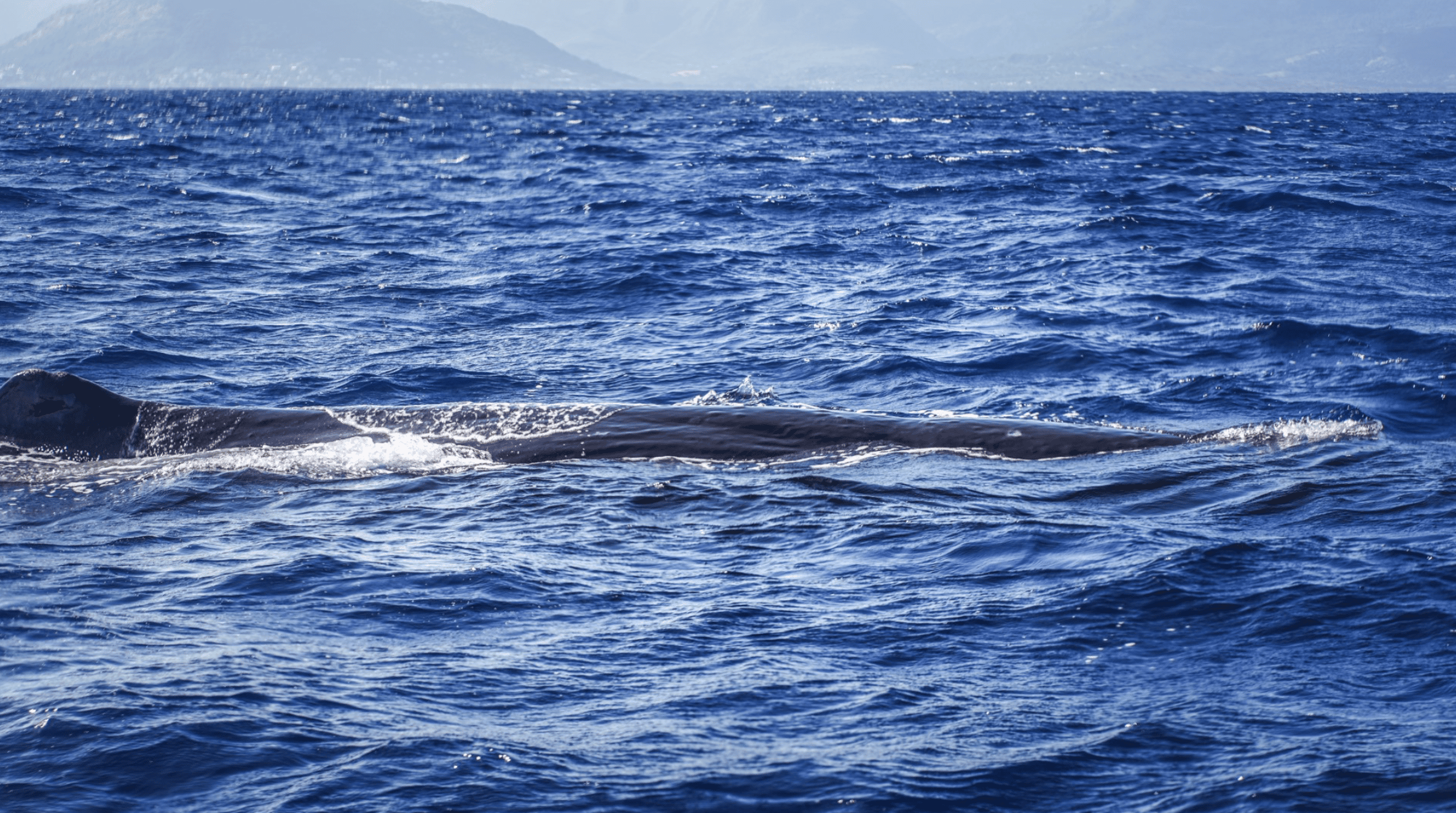
whales show june to september
Meet the pods at first light on a three-hour dawn trip from Grande Riviere Noire, with free cancellation up to 24 hours in advance if your plans change.